
Precision Engineers: How Advanced Micro-Hole Laser Cutting Boosts Component Yield from 65% to 99.2% in Critical Applications
Introduction
In cutting-edge fields like semiconductor manufacturing, medical implants, and aerospace engines, the performance of high-aspect-ratio micro-holes is a matter of product life or death. Traditional methods — micro-drilling or nanosecond laser processing — hit a severe wall: excessive taper ruins fluidic control, an uncontrolled heat-affected zone (HAZ) embrittles the material, and micro-cracks from recast layers cause premature failure in extreme environments. Teams routinely face batch scrap rates of 35% or higher, a catastrophic cost and a major bottleneck for project advancement.
The core issue is fundamentally physical: the energy-matter interaction is too “brutal.” Treating laser cutting merely as a “smaller heat source” fails to solve the exponentially growing challenges of energy deposition, molten ejecta removal, and sidewall quality in deep holes. A true breakthrough requires reimagining the laser cutting process journey as a precision-engineered “photonic expedition,” where the temporal and spatial distribution of light is meticulously programmed. This article deconstructs how next-generation high-aspect-ratio drilling technology, fusing ultrafast lasers, intelligent beam shaping, and closed-loop process control, enables a paradigm shift from “thermal ablation” to “photophysical ablation,” transforming a daunting manufacturing hurdle into a predictable, controlled engineering outcome.
Why Does the “Funnel Effect” Plague Conventional Micro-Hole Drilling, and How Does Physics Dictate the Limits?
The “funnel effect” — where a hole is wider at the entrance than the exit — is the visible symptom of deep-seated physical limitations in conventional micro-drilling. This geometry fails functional requirements for fluid dynamics, filtration, and sealing. The root cause is the inefficient and uncontrolled interaction between the processing energy and the material at depth, where fundamental laws of physics create a cascade of problems that simple tool miniaturization cannot solve.
1. Energy Attenuation and Plasma Shielding in Deep Cavities
As a laser beam penetrates deeper, its energy is scattered and absorbed by the walls and the evolving plasma plume created from vaporized material. This plasma can act as a shield, deflecting or absorbing subsequent laser pulses before they reach the bottom of the hole — a phenomenon known as plasma shielding. This results in reduced effective energy at the cutting front, forcing operators to increase power, which in turn increases unwanted thermal input to the surrounding material, exacerbating the HAZ and making consistent high-aspect-ratio drilling technology elusive.
2. The Molten Ejecta and Recast Layer Dilemma
In thermal processes like nanosecond laser drilling, material is primarily removed by melting. In a deep, narrow hole, evacuating this molten material is extremely difficult. It tends to re-solidify on the cooler sidewalls, forming a brittle, contaminated recast layer. This layer alters the hole’s effective diameter, degrades surface finish, and creates stress concentration points. Furthermore, the need for high-pressure assist gas to clear this debris can itself distort the hole geometry, especially in thin or delicate structures.
3. Taper as an Inevitable Consequence of Energy Profile
A standard Gaussian laser beam has its highest intensity at the center. As it drills, the beam’s energy is naturally more concentrated at the entry point, removing more material there. Without active compensation, this inherent energy profile guarantees a tapered hole. Compounding this, as the focus point is buried deeper, the beam can defocus, further widening the entrance. Mastering how to control taper in laser drilling is therefore not a matter of simple correction but of re-engineering the entire energy delivery system — a foundational challenge for any serious precision manufacturing exploration.
From Nanosecond to Femtosecond: How Does Pulse Duration Redefine the “Heat-Affected Zone”?
The most significant leap in micro-hole laser cutting capability comes from mastering time itself — specifically, the duration of the laser pulse. Moving from nanosecond (10^-9 s) to picosecond (10^-12 s) and ultimately to femtosecond (10^-15 s) pulses fundamentally changes the laser-material interaction from a thermal process to an athermal one. This shift is the key to virtually eliminating the heat-affected zone, a prerequisite for machining sensitive, high-performance materials without compromising their intrinsic properties.
- The Physics of “Cold Ablation” with Ultrashort Pulses: A femtosecond pulse is shorter than the time required for energy to transfer from excited electrons to the material’s lattice as heat (the electron-phonon coupling time). The pulse’s immense peak power instantaneously ionizes the material, converting it directly from a solid to a plasma that expands and dissipates. This process, known as cold ablation or photophysical ablation, removes material with minimal thermal diffusion to the surrounding area. The result is a HAZ often measured in single-digit microns, compared to tens or hundreds of microns with nanosecond lasers, preserving the material’s mechanical strength and corrosion resistance.
- Enabling Precision in Heat-Sensitive and Brittle Materials: This athermal mechanism unlocks the ability to process materials previously considered unfit for laser machining. It allows for clean, crack-free high aspect ratio laser cutting in brittle ceramics (e.g., aluminum nitride for semiconductors), sensitive polymers, and temperature-sensitive alloys. Without a molten phase, there is no recast layer or significant thermal stress, preventing the micro-cracks that lead to catastrophic failure in cyclic loading or harsh environments, which is a cornerstone of advanced manufacturing technology for medical and aerospace components.
- The Trade-off and Strategic Application: The primary trade-off for this quality is speed, as ultrafast lasers typically have lower average power. Therefore, the strategic application is critical. Femtosecond lasers are not for bulk material removal but for achieving micron-level precision and impeccable material integrity where it matters most. They are the tool of choice for the final, most challenging features on a high-value component, or for machining entire parts from exceptionally delicate materials. Understanding this trade-off is essential for integrating this technology into a viable production workflow.
Beyond Percussion: What Advanced Strategies Like Trepanning and Helical Drilling Unlock True Cylindrical Geometry?
Relying on simple percussion drilling — punching straight down with a stationary or pulsed beam — guarantees taper and poor sidewall quality for high-aspect-ratio holes. Advanced motion and path control strategies are required to achieve true cylindrical geometry. Techniques like trepanning and helical drilling transform the laser from a hammer into a scalpel, enabling controlled, precise material removal that defines the hole’s final shape with intention, not as a byproduct of a thermal process.
1. Trepanning: Cutting a Precise Contour
Trepanning involves moving the focused laser beam in a circular path to cut out the entire circumference of the desired hole. Instead of vaporizing material in the center, the beam machines a thin kerf along the edge. This allows molten material or debris to be ejected radially outward more easily. More importantly, it gives the process direct control over the hole diameter and sidewall angle. By dynamically adjusting the beam’s angle of incidence or the path diameter as it cuts deeper, taper can be actively compensated for, which is a hallmark of a professional small hole laser cutting service.
2. Helical Drilling: A Spiraling Path to Depth
Helical drilling takes this a step further by having the laser beam follow a downward spiral path, like a corkscrew. This continuous motion ensures even energy distribution around the hole’s circumference and provides a consistent path for debris ejection. It is exceptionally effective for achieving high depth-to-diameter ratios with excellent sidewall roughness and roundness. This method reduces the peak power density on the material at any single point, further minimizing thermal load and enabling the drilling of deeper, cleaner holes than percussion or even trepanning alone.
3. The Integration of Strategy and Technology
These strategies are enabled by high-precision galvanometer scanners or 5-axis motion systems that can execute complex, 3D toolpaths with micron-level accuracy. The choice between trepanning, helical drilling, or a hybrid approach depends on the material, required aspect ratio, and tolerance specifications. A supplier with deep expertise will simulate and select the optimal strategy during the CAM programming phase. For engineers, understanding that these advanced pathing options exist is crucial for specifying requirements and evaluating a supplier’s precision laser drilling service capabilities for laser cutting for precision parts.
The Invisible Guardian: How Does Real-Time Monitoring and SPC Transform Laser Drilling from Art to Science?
Even with perfect optics and toolpaths, microscopic variations in material composition, surface condition, or laser output can cause drift. The bridge from a successful laboratory demo to reliable mass production is built with real-time process monitoring and statistical process control (SPC). This system of “invisible guardians” collects data on every pulse and every hole, transforming laser drilling from a skilled craft into a data-driven, self-correcting science that guarantees consistency across thousands of parts.
1. Sensors as the Eyes and Ears of the Process
Modern industrial laser applications integrate multiple sensors. Coaxial high-speed cameras monitor the melt pool and plasma plume geometry. Back-reflection detectors measure the amount of light reflected from the workpiece, indicating when breakthrough occurs. Spectrometers analyze the plasma’s emission spectrum, which can reveal the composition of the material being vaporized and even signal contaminants. This multisensory data stream provides a real-time digital twin of the physical drilling event.
2. Closed-Loop Control and Adaptive Compensation
This data is fed back to the machine’s controller in a closed-loop system. If the system detects that the hole depth is progressing slower than expected (perhaps due to a local variation in material hardness), it can automatically increase the pulse energy for the next few pulses. If plasma monitoring suggests excessive spatter, it can adjust the assist gas pressure. This adaptive, in-process compensation maintains the key output characteristics — diameter, roundness, depth — within a tight tolerance band, regardless of minor upstream variations, which is essential for high precision laser cutting in volume production.
3. SPC: The Framework for Predictable Quality
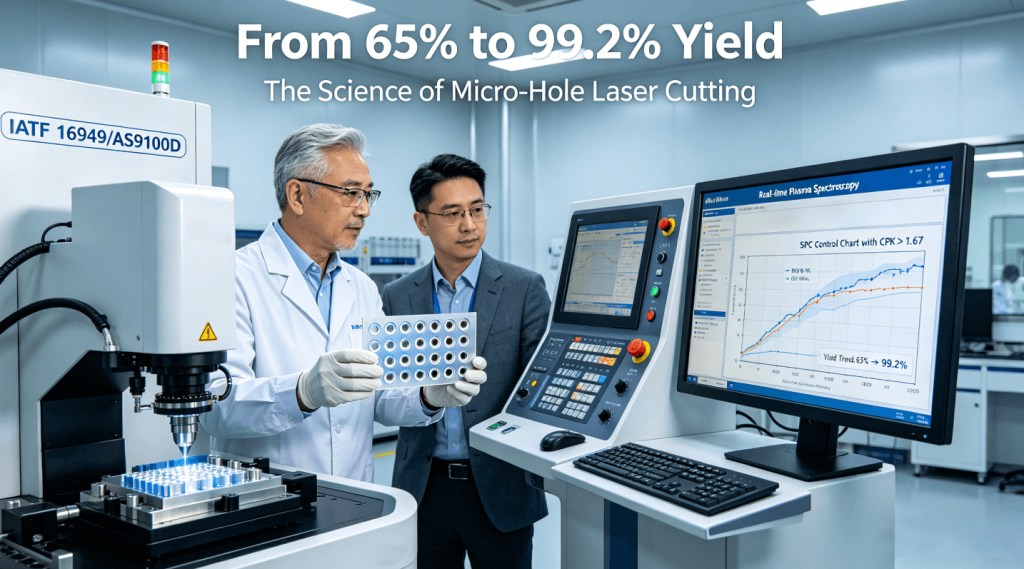
The data from every hole in a production batch is logged and analyzed using Statistical Process Control (SPC) methodologies. Control charts for critical dimensions, like hole diameter, are generated in real-time. These charts don’t just show if a single hole is out of spec; they reveal trends in the process mean and variation. A trained engineer or an automated system can see a trend developing (e.g., gradual diameter increase due to lens heating) and intervene with a parameter adjustment or maintenance before any non-conforming parts are produced. This proactive, data-centric approach is what enables the leap from 65% to 99.2% yield, making small diameter laser drilling a reliable pillar of manufacturing.
From Lab to Production Line: Why Do Certifications Like IATF 16949 Matter for a “High-Tech” Process Like This?
A flawless micro-hole produced in an R&D lab under ideal conditions is a scientific achievement, but it is not a manufacturing solution. The gulf between the two is bridged by institutionalized quality management systems. While ISO 9001 provides the framework for documented procedures, standards like IATF 16949 (automotive) and AS9100D (aerospace) mandate the specific, preventive systems that turn a parameter set into a repeatable, auditable, and scalable industrial process. For a high-stakes technology like ultrafast laser drilling, these certifications are the operating system for risk-free commercialization.
1. APQP and PFMEA: Baking Success into the Process
IATF 16949 enforces Advanced Product Quality Planning (APQP). For a micro-drilling project, this means a cross-functional team must conduct a Process Failure Mode and Effects Analysis (PFMEA) before production begins. They systematically ask: “What if the ceramic substrate has a density variation?” or “How could focal length drift affect hole diameter?” Based on this analysis, preventive controls are designed into the process — such as incoming material certification requirements and in-process vision checks. This upfront, systemic de-risking is the most powerful form of quality assurance.
2. PPAP: Proving Process Capability and Locking the “Recipe”
The culmination is the Production Part Approval Process (PPAP). This is not just delivering a few good samples. It is a comprehensive data package that includes material certs, full dimensional reports, process control plans, and documented evidence of process stability (Cpk studies). The PPAP submission proves that the optimized laser “recipe” (pulse width, energy, path, gas mix) is capable of producing conforming parts consistently. Once approved, this recipe becomes a controlled document, and any change to it requires formal review and re-validation.
3. Traceability and Continuous Improvement: The Cycle of Excellence
These standards mandate complete traceability and a culture of continuous improvement. Every batch of drilled components can be traced back to the raw material lot, the specific machine and program used, the operator, and the full log of production parameters and inspection data. This creates an immutable quality record. Furthermore, the standards require regular internal audits, management reviews, and corrective action systems, ensuring the organization is perpetually learning and improving. This systemic rigor is what transforms a material processing innovation from a laboratory curiosity into a dependable, value-creating pillar of a client’s supply chain.
How to Evaluate a Partner for Your Next Breakthrough Project in Custom Laser Cutting Service?
Selecting the right manufacturing partner for a breakthrough micro-drilling project requires evaluating engineering depth, not just machine lists. The ideal provider acts as a co-development and industrialization partner, bringing a systematic, data-transparent, and quality-obsessed approach to the table. They should demonstrate the ability to not only make a perfect sample but to engineer and document the process that guarantees ten thousand identical ones, de-risking your path to volume production.
1. Interrogating Technical Depth and Development Methodology
During evaluation, present your specific material and performance challenge. A true partner will engage in a technical dialogue about physics, not just specifications. They should explain their rationale for choosing a specific laser wavelength (e.g., green for ceramics) or drilling strategy (helical vs. trepanning). Request to see a sample Process Development Report for a past project, which should detail the experimental matrix, results, and the logic behind the final selected parameters. This demonstrates a methodical, science-based approach to micro-hole machining solutions.
2. Demanding Evidence of Control and Data Transparency
Ask for proof of their process control and quality systems. Can they provide a real-time SPC chart from a current production run? What does their First Article Inspection Report (FAIR) include — does it go beyond basic dimensions to include micrographs of the hole cross-section to show recast layer and HAZ? A partner built on precision drilling guide principles will have this data at hand and be willing to share it to build trust. Their certifications should be evidenced in their deliverables and daily practices.
3. Assessing Partnership Mindset and Long-Term Alignment
The ultimate test is assessing their mindset. Do they ask probing questions about your validation objectives, volume roadmap, and application environment? A supplier that functions as a true custom laser cutting service partner will be invested in your product’s success. They should offer proactive DFM feedback to optimize your design for both performance and manufacturability, suggest material alternatives, and think ahead to scalability challenges. This alignment transforms them from a vendor into an extension of your R&D team, integral to transforming a high-risk development project into a reliable, high-yield production program.
Conclusion
The quest for microscopic perfection in high-aspect-ratio micro-holes has evolved from an “advanced manufacturing technique” to a “core engineering competency” that defines product leadership in semiconductors, medical devices, and aerospace. By embracing a holistic solution that integrates the physics of ultrafast lasers, the intelligence of advanced motion strategies, the vigilance of real-time process control, and the rigor of certified quality systems, engineering teams can decisively overcome this formidable manufacturing bottleneck. This journey transforms micro-hole drilling from a major source of cost and risk into a predictable, high-yield process and a formidable competitive advantage. It represents the reliable translation of cutting-edge photonic science into tangible commercial and performance benefits in the world’s most demanding applications.
FAQs
Q: What’s the practical difference between “high aspect ratio” and just a “deep hole”? When does it become a significant challenge?
A. The challenge escalates non-linearly with the aspect ratio (depth/diameter). A 3:1 ratio is routine; a 20:1 ratio is a major challenge. At high ratios, energy delivery, debris evacuation, and beam focus maintenance become exponentially harder, causing standard processes to fail. This demands specialized high aspect ratio laser cutting strategies like trepanning and dynamic focus control to prevent taper and ensure consistency, which is critical for fluidic or filtration performance.
Q: We need holes in a ceramic substrate. Is laser cutting even possible without cracking it?
A. Yes, with the correct technology. Traditional lasers cause thermal stress cracking. The solution is ultra-short pulse lasers (picosecond/femtosecond) that use “cold ablation” with minimal heat transfer. Coupled with a green or UV wavelength for better ceramic absorption, this enables clean, crack-free micro hole laser cutting in materials like alumina or aluminum nitride, as proven in semiconductor and medical device manufacturing.
Q: How can you guarantee the hole diameter and roundness are consistent for thousands of parts?
A. Consistency is engineered through closed-loop process control. A professional precision laser drilling service uses real-time monitoring (e.g., plasma emission) integrated with Statistical Process Control (SPC). The system makes automatic micro-adjustments to power or focus based on live feedback, ensuring every hole is drilled with identical parameters. This data-driven approach, mandated by systems like IATF 16949, transforms the process into a predictable science.
Q: What information should I provide to get a meaningful quote and technical assessment for a micro-drilling project?
A. For an accurate custom laser cutting service assessment, provide: 1) 3D CAD model, 2) Exact material specification, 3) Critical dimensions and tolerances (diameter, depth, position, finish), 4) The hole’s primary function, and 5) Target volumes. This enables the supplier to evaluate feasibility, recommend the optimal laser and strategy, and provide a realistic quote and lead time for your specific application.
Q: Why might a “small hole laser cutting service” quote seem higher than standard sheet cutting, and is it worth the investment?
A. The higher cost reflects specialized technology (ultrafast lasers, high-precision optics), extensive process development, and rigorous quality control. For small diameter laser drilling, precision and repeatability are paramount, requiring slower speeds and more sophisticated equipment. The investment is justified by the value: eliminating scrap in high-value components, ensuring critical system performance (e.g., injector spray patterns), and preventing catastrophic field failures, converting a high-risk cost into a predictable, high-value capability.
Author Bio
The author is an expert specializing in advanced laser micromachining and industrial process innovation, dedicated to assisting engineering teams in translating groundbreaking materials and design concepts into reliable, high-yield manufacturing outcomes. Working closely with the LS Manufacturing team — which employs a systems engineering approach — the author integrates photonics, data analytics, and quality management methodologies to resolve highly complex manufacturing challenges within regulated industries.