
The Canadian Homeowner’s Guide to Choosing Kitchen Cabinets
A kitchen renovation is one of the most significant home improvement projects a Canadian homeowner can undertake, and cabinet selection is the decision with the greatest impact on the outcome. The right cabinets define how the space looks, determine how it functions day to day, and have a direct effect on resale value. This guide walks through the process step by step. For GTA homeowners already exploring suppliers, factory-direct operations like Morsun Kitchen Cabinets in Richmond Hill are worth keeping on your shortlist as you work through these steps.
Step 1: Define your budget before you shop
The most common mistake Canadian homeowners make when planning a kitchen renovation is approaching cabinet shopping without a defined budget. Kitchen cabinets typically account for 30 to 40 percent of a total renovation budget. On a $30,000 renovation, that puts cabinet spend somewhere between $9,000 and $12,000 for a standard kitchen. Keep these as separate budget items: labour and installation (which add 15 to 25 percent on top of cabinet cost); countertops and backsplash; appliances; and delivery fees, which vary by supplier and location across Canada.
Step 2: Understand the types of kitchen cabinets available
Stock cabinets are pre-built in standard sizes, typically in 3-inch increments, available immediately, and the most affordable option. They work well for kitchens with standard dimensions but offer limited flexibility in sizing and configuration.
Semi-custom cabinets offer more size and finish options than stock, with lead times of a few weeks. They represent a practical middle ground for most Canadian renovation projects in terms of both cost and flexibility.
Custom cabinets are built to exact specifications and suit kitchens with unusual layouts or specific design requirements. They carry the highest price and the longest production timelines, often 10 to 16 weeks.
RTA (Ready-to-Assemble) cabinets are shipped flat-packed and assembled on-site, which reduces shipping volume and cost. A common misconception is that RTA means lower quality. The best RTA products use the same plywood box construction and hardware found in premium fully assembled cabinets. If you are comfortable with basic tools, RTA cabinets can deliver meaningful savings without compromising the end result.
Step 3: Focus on construction quality, not just appearance
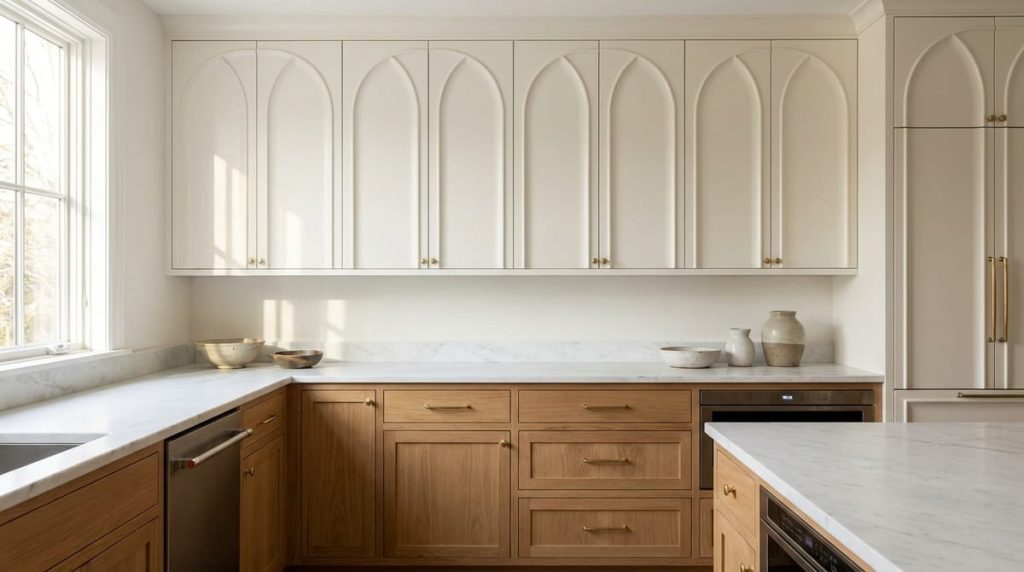
Cabinet doors and finishes attract most of the attention during the design phase, but the box behind the door is the structural foundation that determines how long the installation holds up.
Plywood boxes are the industry standard for quality. Plywood’s cross-grain construction makes it strong, moisture-resistant, and reliable at holding screws over years of use. In a kitchen where humidity fluctuates and the area near the sink and dishwasher sees regular moisture exposure, plywood holds up significantly better than the alternative. Particleboard is cheaper to manufacture but absorbs moisture readily, swells at edges, and loses its grip on screws over time. The difference is most noticeable in base cabinets over several years of use.
On drawers, look for dovetail joints at the corners and soft-close undermount glides. These construction details reliably separate products built to last from those built primarily to a price point.
Step 4: Choose a door style that suits your home
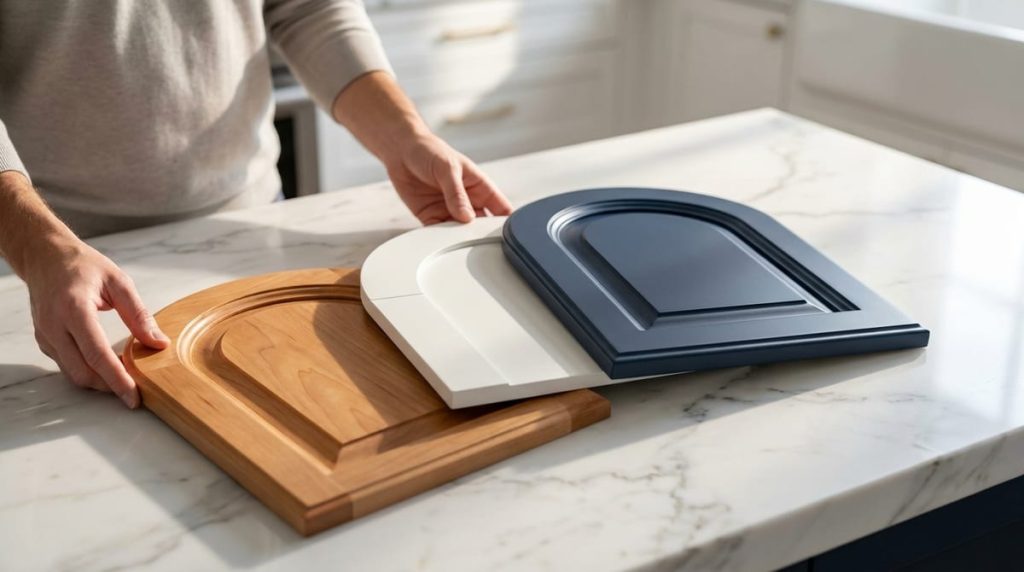
Shaker doors feature a clean profile with a recessed centre panel and are the most versatile option, working equally well in modern, transitional, and traditional kitchens. They are also among the easiest to maintain. Flat panel (slab) doors offer a minimalist look popular in condos and contemporary homes. Matte finishes are a practical choice for these, as they show fingerprints less readily than gloss. Raised panel doors suit traditional and heritage-style properties and add a more layered, classic appearance.
When selecting a finish, consider durability alongside aesthetics. Ask about edge sealing in particular, as this is where lower-cost finishes tend to fail first.
Step 5: Find a supplier you can trust
Kitchen cabinet suppliers in Canada range from large retail chains and big-box stores to boutique showrooms and factory-direct operations. The channel you buy through has a real effect on what you get for your money. Factory-direct suppliers remove intermediaries from the supply chain, which typically results in better construction quality at lower prices than comparable retail options, combined with deeper product knowledge.
Morsun Kitchen Cabinets in Richmond Hill — mentioned above as a starting point — offers plywood box construction, dovetail drawer joints, and soft-close hardware as standard, along with a free 3D design service that lets homeowners visualize their kitchen layout before placing an order. For those looking to get quality cabinets without a retail markup, this type of direct supplier relationship is worth exploring early in the planning process.
Step 6: Get measurements and layout confirmed before ordering
Before placing any cabinet order, make sure you have accurate measurements of the kitchen space, including ceiling height, window and door placements, and any structural features like columns, pipes, or irregular walls. Confirm appliance dimensions so cabinet configurations can be designed around them from the start. Use a 3D design service if your supplier offers one, as a rendered view of your finished kitchen is significantly more useful for final decision-making than a floor plan.
Common mistakes worth avoiding
Prioritizing style over construction is the most frequent error homeowners make. A well-finished door on a low-quality box is a trade you will regret. Underestimating lead times causes problems mid-renovation; custom and semi-custom products often take 8 to 12 weeks. And failing to budget for accessories creates surprises at the end. Filler strips, crown moulding, pull-out shelves, and interior organizers are frequently priced separately and add up quickly if they are not accounted for from the beginning.
A kitchen renovation done well is an investment that improves daily life for the next 15 to 20 years. A methodical approach to the cabinet decision, and choosing a supplier who delivers genuine quality at a fair price, is the foundation of getting that right.